How to Convert Hourly to Yearly Salary: A Complete Guide
Introduction
Many people who work hourly jobs may wonder, "How much do I make annually?" It’s a valid question, especially when comparing different job offers or budgeting for the year ahead. Converting your hourly to yearly salary is a simple yet crucial calculation to better understand your annual earnings. This guide will break down how to convert your hourly wage to a yearly salary, explain how assumptions in the calculation affect the results, and help you estimate what you can expect to earn annually based on your hourly pay.
What does "Hourly to Yearly Salary" Mean?
The phrase "hourly to yearly salary" refers to the process of estimating how much you could earn in a year if you work full-time based on your hourly wage. This conversion is helpful because it allows you to compare hourly jobs with salaried positions, even though you may be paid differently. In simple terms, it turns your hourly wage into an estimate of what you could earn over 12 months of consistent work.
For example, if you are paid $15 per hour, understanding how that translates into an annual salary will help you compare it to other job offers and plan your financial goals.

How to Convert Hourly to Yearly Salary: Basic Formula
To convert hourly to yearly salary, you can use a simple formula. This calculation assumes you work 40 hours per week for 52 weeks a year:
Yearly Salary = Hourly Rate × Hours Worked per Week × Weeks Worked per Year
Here’s how you can apply this formula in a real-world scenario:
-
Example 1:
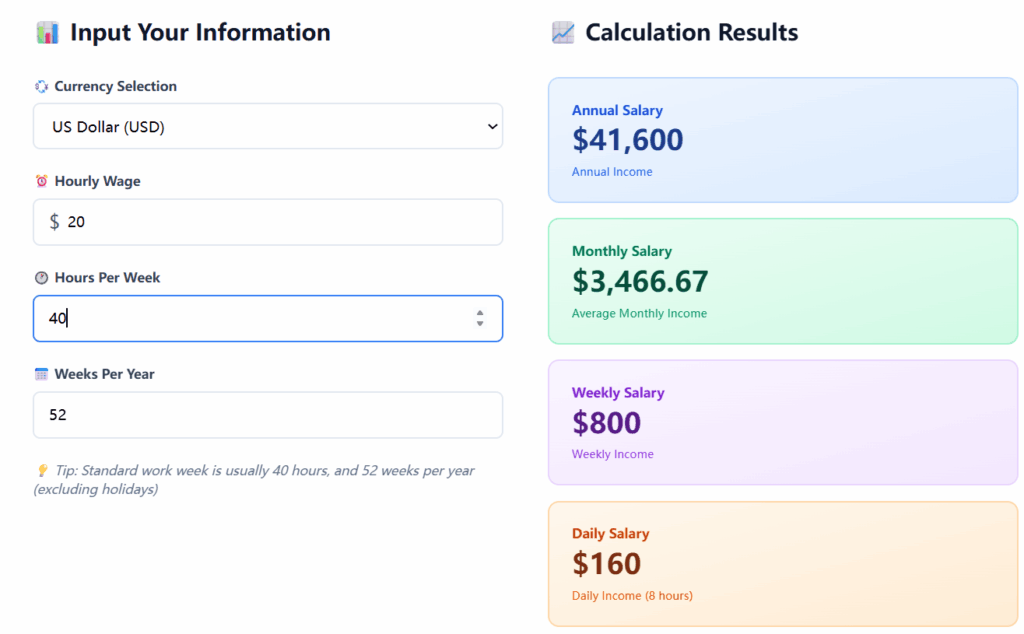
If your hourly rate is $20, and you work 40 hours a week for 52 weeks, the conversion to yearly salary would be:
$20/hour × 40 hours/week × 52 weeks/year = $41,600/year. -
Example 2:
If your yearly salary is $50,000, and you work 40 hours a week for 52 weeks, the conversion to hourly wage would be:
$50,000/year ÷ (40 hours/week × 52 weeks/year) = $24.04/hour
This gives you an approximate gross yearly salary before taxes and deductions.
Why is It Important to Convert Hourly to Yearly Salary?
Converting your hourly to yearly salary is important for a few reasons:
- Comparing Pay Scales: It helps you compare hourly wages to salaried positions on a similar scale, making it easier to understand the value of different job offers.
- Financial Planning: Knowing how much you will earn annually allows you to plan for expenses, savings, and investment goals. It provides a clearer picture of what to expect each year financially.
- Evaluating Job Security: By converting hourly to yearly salary, you gain a sense of job security, especially when considering whether your earnings will be enough to support your lifestyle and long-term goals.
Factors That Affect Hourly to Yearly Salary Conversion
The conversion from hourly to yearly salary is a good estimation, but it assumes certain factors that may not apply to all situations. Here are some key considerations to keep in mind:
- Vacation and Sick Days: The calculation assumes you work all 52 weeks of the year. If you take unpaid leave, your actual yearly salary will be lower.
- Overtime: If your job pays overtime for hours worked beyond 40 per week, you need to adjust the formula to account for these additional earnings.
- Part-Time Hours: If you work less than full-time hours, your actual yearly salary will be lower. You’ll need to adjust the weekly hours in the formula to get a more accurate result.
How to Adjust the Hourly to Yearly Salary Calculation for Realistic Scenarios?
If your situation differs from the assumptions made in the basic formula, here’s how you can adjust the hourly to yearly salary conversion to better reflect your real earnings:
-
Adjust Weeks Worked per Year: If you expect to take time off or have unpaid days, reduce the number of weeks in your year. For instance, if you plan for 4 weeks of vacation, you’d adjust the calculation to:
$20/hour × 40 hours/week × (52 - 4 weeks) = $38,400/year. - Include Overtime: If you regularly work overtime, add those additional hours and pay rates to the formula.
-
Part-Time Work: If you’re a part-time worker, adjust your hours worked per week to reflect your actual schedule. For example, if you work 30 hours per week, the formula becomes:
$20/hour × 30 hours/week × 52 weeks/year = $31,200/year.
By making these adjustments, you’ll get a more accurate yearly salary estimate.
When to Use Hourly to Yearly Salary Conversion?
It makes sense to use the hourly to yearly salary conversion when:
- You’re comparing hourly pay with salaried compensation.
- You want to estimate your potential earnings for the upcoming year.
- You’re planning a budget based on your income.
However, if you have irregular work hours, variable pay (like commissions), or frequent time off, you may want to use a more detailed calculation or method that accounts for these factors.
Conclusion
Converting your hourly to yearly salary is a simple but powerful way to understand your potential income over the course of a year. Whether you’re comparing jobs, planning your finances, or evaluating job offers, this conversion can provide clarity on your overall earnings. Remember, the hourly to yearly salary conversion is just an estimate, and adjustments may be needed based on factors like vacation time, overtime, or irregular work schedules.
